
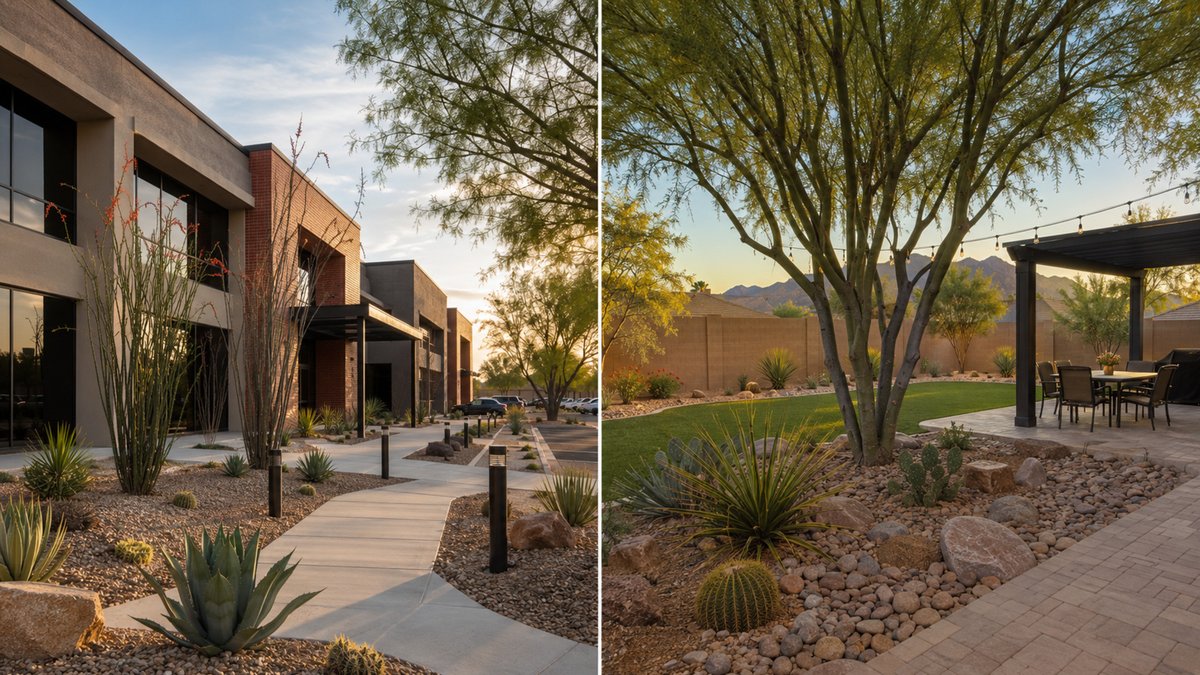
Commercial landscape design follows different priorities than residential work, even when the plants and materials look similar. Commercial and residential landscapes may use many of the same plants and materials, but the design process is not the same. A home landscape is usually shaped around one household. A commercial landscape must serve more people, satisfy operational requirements, and remain manageable within a long-term property budget.
Understanding those differences helps owners start with the right priorities.
The number of users changes the design
Residential design begins with how the household wants to live outdoors: entertaining, relaxing, gardening, creating shade, improving privacy, or changing the view from inside the home.
Commercial design must consider multiple user groups. Depending on the property, those may include tenants, customers, employees, residents, delivery teams, maintenance crews, and emergency responders. Circulation, visibility, gathering spaces, wayfinding, and the relationship between vehicles and pedestrians become central decisions.
Commercial landscapes carry operational responsibilities
At a commercial site, landscape design interacts with parking, signage, utilities, drainage, lighting, security, access, and building operations. A beautiful plant in the wrong location can obscure a sign, interfere with a sightline, block equipment, or require constant pruning.
The design should account for mature plant size—not just how the installation looks on opening day. It should also allow crews to safely access irrigation components and maintain the property without repeatedly disrupting tenants or customers.
Durability has a larger role
Residential spaces may have lighter traffic and closer day-to-day oversight. Commercial materials and plants often face heavier use, reflected heat, vehicle exposure, foot traffic, and less predictable behavior.
That does not mean every commercial landscape must look hard or minimal. It means each material should be selected for its location. A quiet courtyard, busy retail entry, apartment pool area, and industrial frontage require different responses.
Irrigation planning is more complex
Water efficiency matters in both settings, especially in Tucson. Commercial properties, however, may contain more zones, multiple controllers, large distances, mixed plant types, and operational constraints on watering times.
A good plan groups plants with similar water needs, creates serviceable zones, and places components where they can be inspected. The Arizona Department of Water Resources recommends regionally appropriate design, plant selection, and efficient irrigation practices for water-wise landscapes.
Arcadia Landscape can integrate commercial irrigation systems with the broader landscape plan.
Maintenance should influence design from the beginning
Every landscape requires care, but the type and frequency can vary dramatically. Before selecting a design direction, ask:
- How often will pruning be required?
- Will fallen flowers, pods, leaves, or fruit affect walks and parking?
- Can weeds be accessed and managed?
- Will decorative rock migrate into pavement?
- Are trees appropriately placed for their mature canopies and roots?
- Can irrigation be repaired without damaging finished areas?
- Which elements will require periodic replacement?
Commercial design works best when the maintenance team is part of the planning conversation.
Approvals and budgets differ
A homeowner may be the primary decision-maker. Commercial projects can involve ownership, property management, tenants, boards, architects, contractors, municipalities, and other reviewers. These stakeholders may have different goals and approval timelines.
Commercial budgets also need to distinguish installation cost from long-term operating cost. A lower initial price is not necessarily the best value if the design requires frequent replacement, intensive pruning, or inefficient watering.
The shared goal: a landscape that belongs to the site
Both residential and commercial landscape design should respond to architecture, climate, use, and the people who experience the space. In Southern Arizona, thoughtful plant selection, shade, efficient irrigation, and appropriate hardscape can create an outdoor environment that feels intentional rather than generic.
Arcadia Landscape provides landscape design in Tucson for commercial and residential clients, along with installation and ongoing commercial maintenance.
What sets commercial landscape design apart
Strong commercial landscape design plans for many users, durability, safety, and maintenance access rather than the preferences of a single household.
Request a landscape design consultation to turn your goals into a practical site plan.