
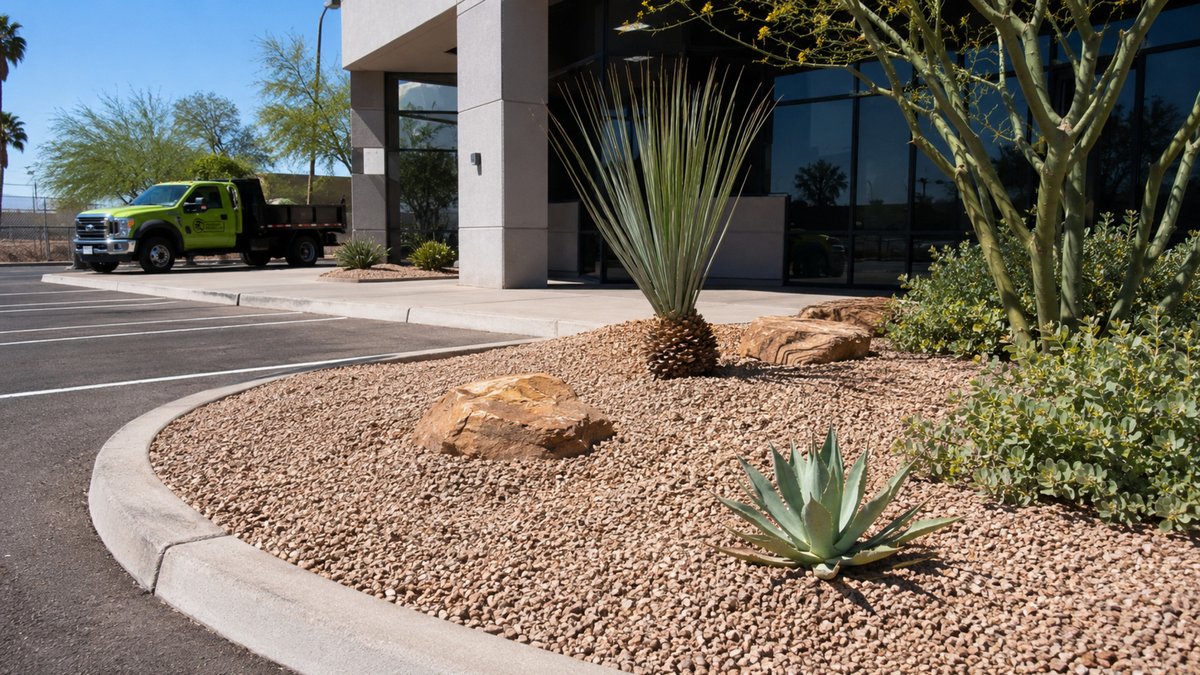
Decorative rock is a durable ground cover choice for Tucson commercial landscapes, but it is not the right answer in every planting area. Decorative rock is a familiar part of Tucson’s commercial landscape. Compared with organic mulch, it changes slowly, resists decomposition, and maintains a consistent visual field through heat and dry weather. Those qualities can make it a practical surface material—but longevity is only one factor in the decision.
The right material depends on the planting, microclimate, drainage, maintenance plan, and desired appearance.
Why rock generally lasts longer
Organic mulch is designed to change. Wood chips, bark, and other plant-based materials break down, move, fade, and eventually become part of the soil. That process can support soil improvement, but it also means the material needs periodic replenishment.
Decorative rock does not decompose on the same cycle. It may migrate, settle into soil, collect sediment, or require refreshing, but the mineral material itself remains. On a large commercial site, this can create a more stable long-term appearance and reduce the frequency of full surface replacement.
Rock performs well in windy, exposed settings—when detailed correctly
Appropriately sized and installed rock is less likely than lightweight organic material to blow across walks or parking areas. Edging, grade, drainage, and particle size matter. Rock placed above adjacent pavement or in concentrated runoff paths can still migrate and create cleanup problems.
The installation should preserve drainage function and keep material away from trunks, valve boxes, drains, and other service points.
The heat tradeoff matters
Rock can absorb and radiate heat. In areas with intense western exposure, reflected heat from walls, pavement, and light-colored stone may increase stress on nearby plants and discomfort for pedestrians.
Organic mulch can moderate soil temperature and reduce evaporation, particularly around plants that benefit from a more protected root zone. A site does not have to use one material everywhere. Rock may fit broad public-facing areas, while organic mulch may be appropriate in selected planting beds or shaded zones.
Weed control is not automatic
Neither decorative rock nor mulch guarantees a weed-free landscape. Windblown dust and seeds accumulate over time. Irrigation and rainfall create opportunities for weeds to establish above fabric or within decomposed material.
Good weed management combines proper surface preparation, material depth, irrigation control, monitoring, and timely treatment. Avoid treating rock as a substitute for a weed-control plan.
Decorative rock supports a consistent commercial appearance
Rock provides color, texture, and visual continuity between widely spaced desert plants. It can help define entries, medians, signs, and broad frontage areas without competing with architecture.
Selection should consider:
- Color in direct sun and shade
- Contrast with buildings and paving
- Particle size near pedestrian areas
- Availability for future matching
- How sediment and plant litter will appear
- Compatibility with existing site materials
Trendy colors can be difficult to match years later. A locally available, repeatable specification often serves commercial properties better.
Life-cycle cost is more useful than installation cost alone
Compare the initial material and installation price with future replenishment, cleanup, weed management, and repair. Rock may cost more to install or modify, while organic mulch may require more frequent additions. Neither is universally less expensive.
The best choice supports the plant community and the maintenance standard the property can sustain.
Plan the enhancement as part of the landscape
Arcadia Landscape provides commercial xeriscape and landscape enhancement services for Tucson properties. The team can evaluate decorative rock together with planting, irrigation, drainage, and ongoing maintenance.
Where decorative rock is the right choice
Choosing decorative rock for the right areas balances longevity against plant health, and pairing it with sound plant selection matters more than the ground cover alone. Plant guidance from the University of Arizona Cooperative Extension can help.
Request a commercial enhancement estimate for a material plan that fits your site.