
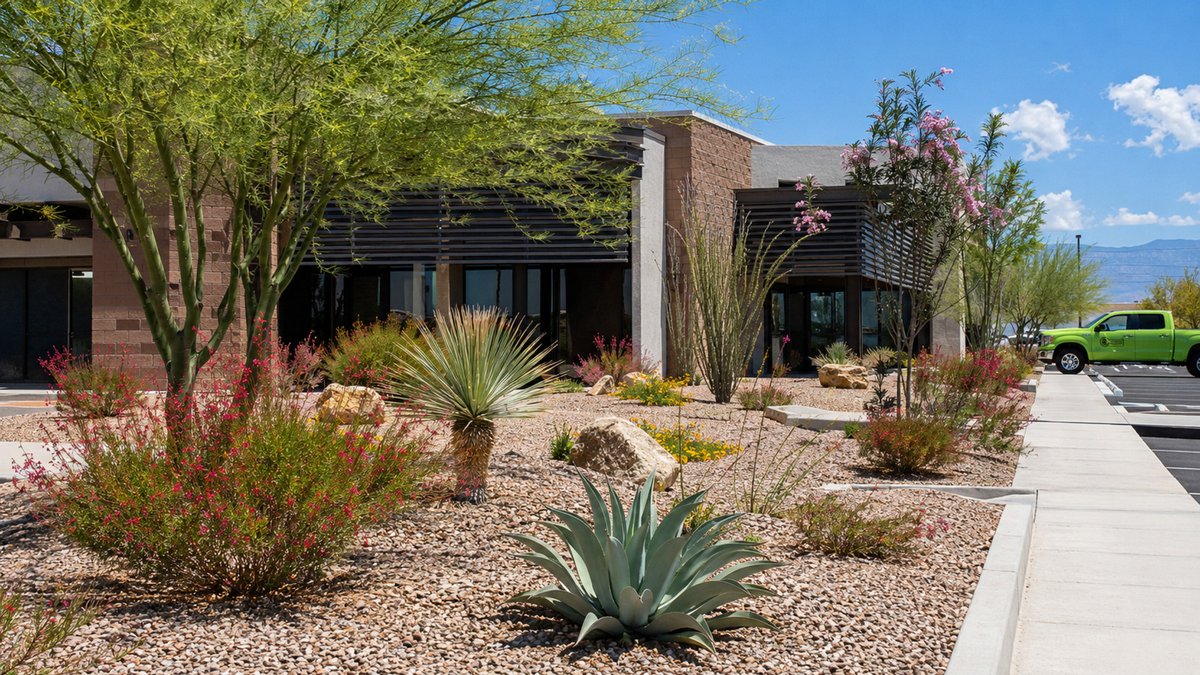
Selecting heat-tolerant plants for a Tucson commercial site means matching species to reflected heat and microclimates, not just a nursery label. A plant labeled “full sun” is not automatically suited to every Tucson commercial site. Heat reflected from glass, walls, pavement, and decorative rock can create conditions more severe than an open nursery display. Wind, drainage, irrigation, traffic, and maintenance access also affect performance.
Plant selection should begin with the site—not a list of attractive species.
Map exposure and microclimates
Walk the property at different times of day. Identify western walls, parking-lot islands, shaded courtyards, roof runoff, low drainage areas, wind corridors, and zones surrounded by pavement. These microclimates may need different plant palettes even when they are close together.
New plants near reflective surfaces often need careful establishment and irrigation monitoring. A species that tolerates desert heat may still fail if its roots remain too wet, the soil drains poorly, or it is installed at the wrong depth.
Use the Tucson low-water-use plant list as a starting point
The Arizona Department of Water Resources maintains low-water-use and drought-tolerant plant lists for Active Management Areas, including Tucson. These resources help narrow the field, but selection still requires project-specific evaluation.
Potential commercial landscape groups may include desert-adapted trees, flowering shrubs, accent plants, grasses, and groundcovers. Examples commonly used in Southern Arizona designs include palo verde, desert willow, desert ironwood, Texas ranger, fairy duster, chuparosa, brittlebush, desert spoon, red yucca, and selected agaves. Confirm the exact species or cultivar, mature size, cold tolerance, thorns, litter, and placement before specifying it.
Design for mature size
Small nursery plants can become large trees, broad shrubs, or sharp architectural accents. Check mature height and spread, then provide room around sidewalks, signs, windows, vehicles, utilities, and sightlines.
Choosing the right size reduces repeated shearing and plant replacement. It also preserves the natural form that makes desert-adapted plants visually distinctive.
Group plants by water needs
Plants with similar water requirements should share irrigation zones where practical. A drought-tolerant plant can decline when watered on the same schedule as a high-use planting. Conversely, a newly installed plant may require establishment watering even if its long-term need is low.
The irrigation plan should evolve as plants establish. Arcadia Landscape offers commercial irrigation services for new and existing properties.
Evaluate commercial maintenance behavior
Ask how the plant responds to pruning, how much litter it produces, whether it reseeds, and whether pests or seasonal dormancy affect appearance. Consider whether fallen pods or flowers will collect on walks, whether spines can reach pedestrian areas, and whether crews can safely access the plant.
No plant is maintenance-free. The goal is a palette whose care requirements match the property standard and budget.
Use shade strategically
Trees can improve comfort and reduce harsh exposure, but placement requires long-term thinking. Consider canopy spread, roots, clearances, visibility, and irrigation. A tree planted too close to a sign or building may create decades of conflict.
Prioritize useful shade over scattered planting. Entrances, gathering areas, pedestrian routes, and selected parking zones may benefit most.
Build variety without creating chaos
Commercial landscapes often perform well with a repeatable core palette plus selected focal plants. Repetition creates identity and simplifies care. Accent species can mark entries or gathering spaces without turning every bed into a different maintenance challenge.
Arcadia Landscape provides commercial xeriscaping in Tucson and can coordinate plant selection, irrigation, installation, and ongoing maintenance.
Matching heat-tolerant plants to each microclimate
Placing heat-tolerant plants according to exposure, drainage, and reflected heat produces a more durable commercial landscape than sun-rating labels alone.
Request a heat-tolerant landscape enhancement plan for your property.