
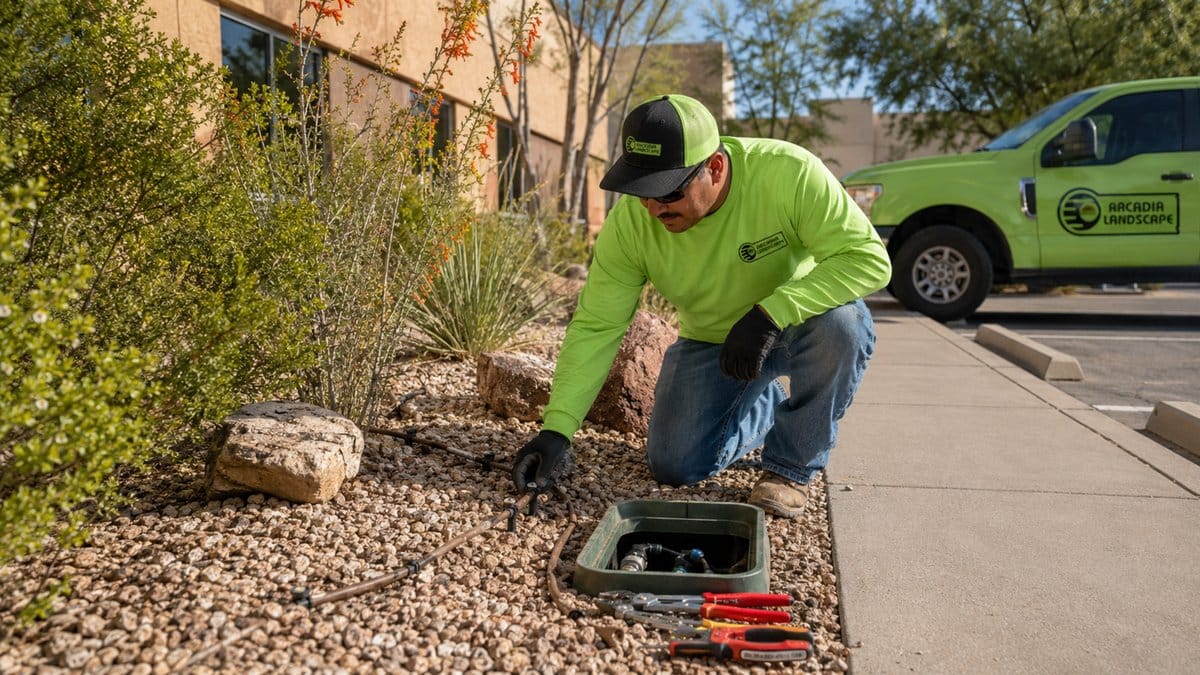
Preparing commercial irrigation systems before summer is far easier and cheaper than reacting to failures during peak heat. An irrigation problem that is manageable in spring can become expensive and highly visible during a Tucson summer. Plants face greater stress, water demand rises, and a hidden leak can run through many scheduled cycles before anyone notices it.
Preparing a commercial irrigation system is not simply a matter of adding minutes to the controller. It requires confirming that the system delivers water where it is needed, at an appropriate rate, without creating runoff or damage.
Start with a complete zone-by-zone test
Activate each zone manually and watch an entire cycle. The goal is to see what the controller cannot show you. Document:
- Zones that do not start or shut off correctly
- Broken, tilted, blocked, or mismatched spray heads
- Clogged, missing, or displaced drip emitters
- Cracked tubing and wet spots along buried lines
- Overspray onto sidewalks, walls, windows, or vehicles
- Water flowing away from the intended root zone
- Plant material blocking distribution
Test during daylight when practical, even if normal irrigation occurs early in the morning. Problems are much easier to diagnose when someone can observe them.
Repair leaks before changing schedules
Increasing runtime will not correct poor distribution. It may only magnify a leak or send more water onto pavement. Fix obvious failures first, then evaluate whether the repaired system provides adequate coverage.
Pay particular attention to valves that do not close completely, continuously wet boxes, damaged lateral lines, and emitters that have been enlarged or replaced inconsistently. On large properties, a small recurring loss can become a significant operational issue.
Arcadia Landscape’s commercial irrigation repair services address problems ranging from individual components to larger system failures.
Match irrigation to plant groups
Trees, shrubs, groundcovers, annual color, and turf should not automatically share the same watering pattern. Their root depths and application methods differ. Mixed zones often create a compromise in which one plant group receives too much water while another receives too little.
Where possible, group plants with similar water needs and use an application method appropriate to the root zone. This principle—often called hydrozoning—also makes future scheduling and troubleshooting more manageable.
Update the controller deliberately
Review start times, watering days, runtimes, seasonal adjustments, and rain or weather settings. Remove obsolete programs left from previous seasons or landscape changes. Confirm that the controller’s clock, date, and station labels are accurate.
Smart controls can be useful, but they still depend on correct setup and a functional irrigation system. A connected controller cannot compensate for a broken valve, clogged emitter, or poorly designed zone.
Check pressure and application behavior
Misting spray, uneven throw, fogging, or weak coverage may indicate pressure problems or incompatible components. On drip systems, inspect filters and pressure regulation. On sloped or compacted areas, use shorter cycles if necessary to allow water to soak in rather than run off.
The Arizona Department of Water Resources recommends efficient irrigation practices and offers guidance on system inspection, repair, and water-use planning for commercial facilities.
Build a summer response plan
Decide who receives reports of leaks or stressed plants, how after-hours issues will be handled, and which areas are most critical. Map controller locations, shutoff points, valves, and backflow assemblies. Current records can save time when a leak affects a customer entrance or high-traffic area.
Schedule follow-up inspections
Summer preparation is the starting point, not the final step. Commercial systems should be observed as temperatures and weather patterns change. Arcadia Landscape offers commercial irrigation services in Tucson, including repair, replacement, installation, upgrades, and seasonal maintenance options.
A pre-summer commercial irrigation systems checklist
Inspecting commercial irrigation systems zone by zone before summer confirms coverage, pressure, and scheduling while repairs are still simple and inexpensive.
Request an irrigation assessment before summer demand peaks.