
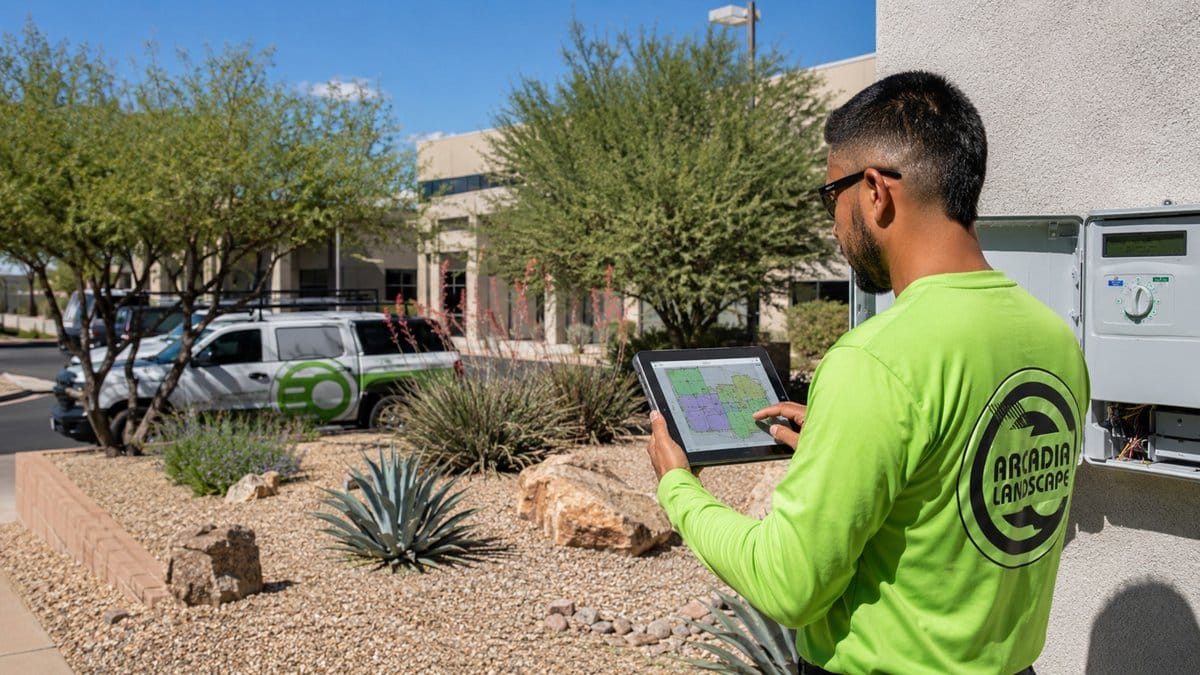
Smart irrigation controllers can lower commercial water costs by scheduling from weather and site data instead of a fixed calendar. Smart irrigation controllers can improve commercial landscape scheduling by using weather data, sensors, site information, or a combination of inputs instead of relying only on a fixed calendar. The potential benefit is fewer unnecessary cycles and faster adjustment as conditions change.
The controller is not a cure for every irrigation problem. Savings depend on system condition, configuration, plant grouping, oversight, and the property’s starting point.
Fixed schedules are easy to forget
A conventional controller may run the same program until someone changes it. If a temporary summer schedule remains active after weather changes, or a station has multiple start times, water use can continue unnoticed.
Smart controllers can automate part of the seasonal adjustment process and make system status easier to review remotely. Alerts and flow data may help teams identify unusual conditions sooner, depending on the equipment and connected components.
Weather-based scheduling can reduce unnecessary watering
Weather-based controllers estimate landscape demand using information such as temperature, solar conditions, wind, humidity, and rainfall. Soil-moisture-based systems use field sensors to inform watering decisions.
Neither approach removes the need for setup. The controller must know the landscape’s plant type, exposure, soil, application method, slope, and other site factors. Incorrect inputs can produce an incorrect schedule more efficiently.
Flow monitoring can reveal abnormal use
Where compatible flow sensing is installed and configured, the system may detect use outside an expected range. This can help identify a stuck valve, broken line, or other abnormal event.
Alerts are only valuable when someone receives and acts on them. Define notification contacts, response thresholds, after-hours procedures, and shutoff authority before relying on the feature.
The field system must work first
A smart controller cannot repair:
- Broken or clogged emitters
- Leaking valves or pipes
- Mismatched spray heads
- Excessive or inadequate pressure
- Poorly grouped plant types
- Overspray caused by layout or obstruction
- Missing backflow or code-related components
Inspect and repair distribution before evaluating performance. Arcadia Landscape provides commercial irrigation upgrades as well as repairs and replacement.
Measure results with a baseline
To understand whether an upgrade is working, record water use before and after installation while noting weather, rates, occupancy, landscape changes, and repaired leaks. Compare like periods when possible.
Do not promise a universal savings percentage. A property with a well-managed schedule may see a different result from a site with duplicate programs and major leaks.
Plan for access and continuity
Commercial controllers should have secure physical access, documented logins, current site maps, labeled stations, and a handoff process when staff or vendors change. Consider connectivity, subscription requirements, replacement parts, support, and what happens if the network is unavailable.
Keep a clear manual operating procedure for critical situations.
Use available conservation resources
Tucson Water offers conservation information and commercial or multifamily programs that may change over time. The Arizona Department of Water Resources also provides commercial water-management tools and landscape irrigation inspection resources. Check current eligibility and terms directly with the program before planning a project around a rebate or incentive.
Choose the upgrade around the property
The best controller is not necessarily the one with the longest feature list. It is the one that supports the site’s number of zones, flow, plant palette, staff capabilities, response process, and maintenance plan.
What smart irrigation controllers change
Used well, smart irrigation controllers reduce unnecessary cycles and flag problems earlier, but they still depend on sound zones and regular inspection.
Request a smart-irrigation upgrade assessment from Arcadia Landscape to evaluate the controller together with the field system.