
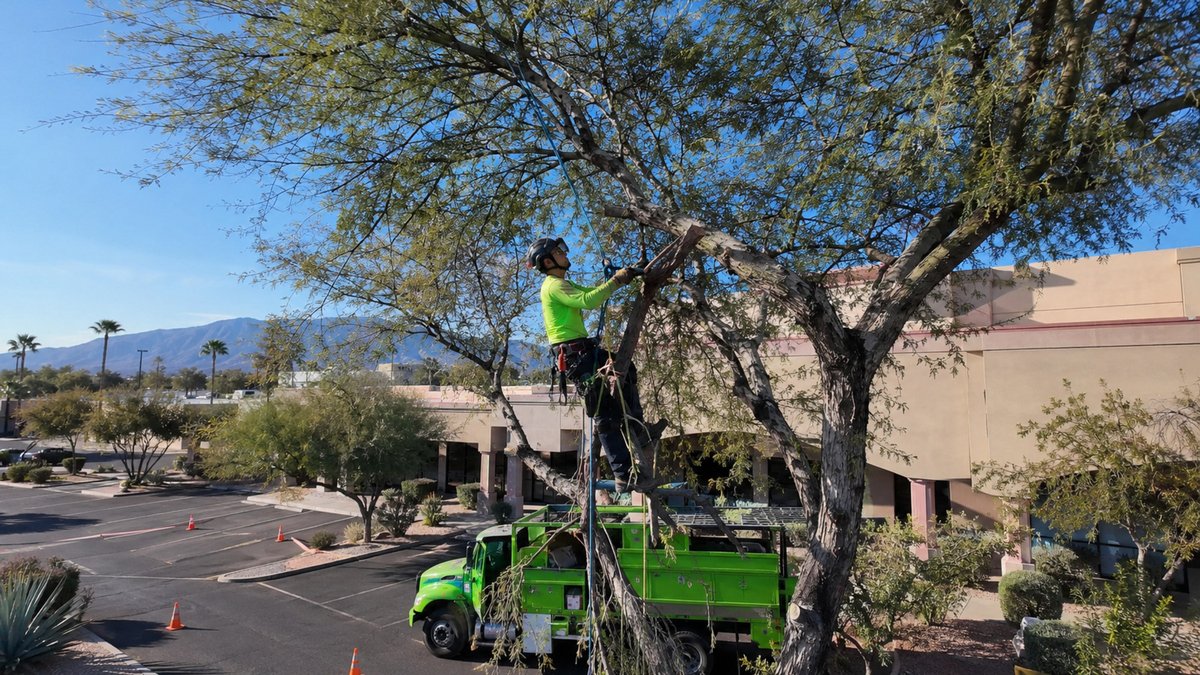
Summer tree pruning on a Tucson commercial property should have a clear, defined purpose rather than following a fixed calendar. Tree pruning during a Tucson summer should have a clear purpose. Routine heavy pruning can add stress during extreme heat, expose previously shaded bark, and remove foliage the tree uses to produce energy. At the same time, broken limbs, clearance conflicts, and immediate hazards cannot always wait for a cooler season.
The right decision depends on the tree, condition, objective, and site.
Separate urgent work from routine pruning
Urgent evaluation may be appropriate when a branch is broken, hanging, blocking essential access, resting on a structure, or creating an immediate concern near people or vehicles. Storm damage can also require prompt work.
Routine size reduction, aesthetic shaping, and broad canopy thinning usually provide more scheduling flexibility. University of Arizona Cooperative Extension seasonal guidance advises avoiding heavy pruning of most trees and shrubs during the hottest period unless monsoon damage is involved.
Pruning does not make every tree storm-proof
Removing the right defective branch may reduce a specific concern. Excessive canopy removal, topping, or stripping interior growth can create new problems. Trees need species-appropriate structure and enough foliage to function.
Beware of blanket promises to “windproof” a tree. A professional should identify the objective and explain what pruning can—and cannot—accomplish.
Commercial clearance needs are specific
Property owners often need branches cleared from:
- Walkways and accessible routes
- Parking spaces and drive aisles
- Building roofs and facades
- Monument and tenant signs
- Site lighting and security cameras
- Service areas and delivery routes
- Vehicle sightlines
Specify the required clearance and observe how the space is used. Repeatedly pruning a tree away from a permanent conflict may indicate that the species or location is unsuitable.
Protect bark from sudden exposure
Intense desert sun can damage bark and limbs that were previously shaded by dense foliage. Large changes to a canopy during summer may expose sensitive tissue. This is another reason to favor conservative, purposeful work and to plan major structural pruning for a more appropriate season when possible.
Inspect before monsoon storms
An inspection can identify dead limbs, cracks, weak attachments, recent lean, root-zone disturbance, and conflicts with structures. Not every visible condition predicts failure, and risk cannot be eliminated. The value of inspection is to identify concerns that deserve action or monitoring.
Keep records and photos, especially for high-use areas and trees with previous work.
Ask what will be removed and why
A pruning proposal should identify objectives rather than rely on vague terms such as “trim trees.” Ask:
- Which branches or areas are the priority?
- Is the purpose clearance, deadwood removal, structural improvement, or restoration?
- How much live canopy is expected to be removed?
- Is the timing appropriate for the species?
- How will the work zone be protected?
- What follow-up inspection is recommended?
Use trained professionals for complex work
Tree work near buildings, traffic, utilities, or occupied areas requires appropriate training, equipment, and work-zone controls. Do not attempt to prune near electrical conductors; contact the utility or qualified line-clearance professionals.
Arcadia Landscape provides tree-pruning services in Tucson for commercial and residential properties as part of a broader tree-care program.
Separating urgent work from routine summer tree pruning
Limiting summer tree pruning to safety and clearance needs reduces heat stress on trees while still protecting people, vehicles, and buildings.
Request a tree-pruning assessment to prioritize necessary work without over-pruning during summer.