
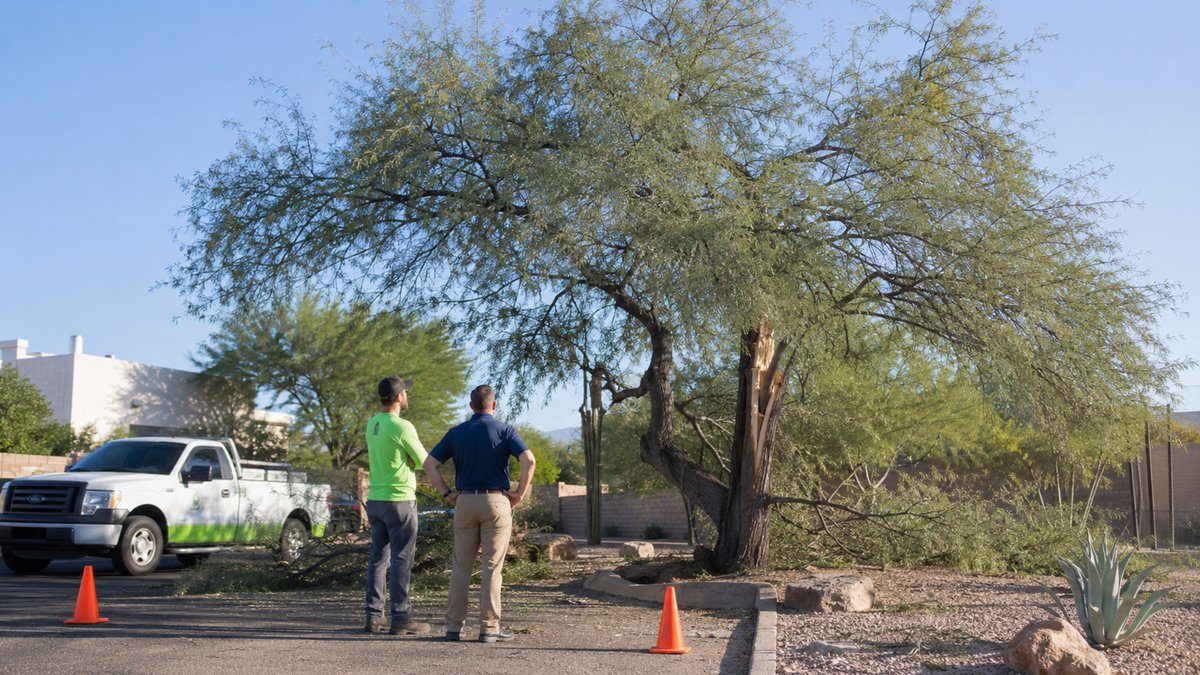
Tree removal is sometimes the safer decision when pruning cannot correct a tree’s structural problems or location. Pruning can remove deadwood, improve clearance, and address some structural concerns. It cannot correct every defect or make every tree suitable for its location. When a tree is severely compromised or presents a level of risk that cannot be reduced to an acceptable level through reasonable care, removal may be considered.
That decision should follow an on-site assessment. Photographs or a checklist cannot capture every condition.
The tree has severe structural damage
Major trunk cracks, extensive splitting, large broken leaders, significant root-plate movement, or multiple failures may leave too little sound structure for pruning to provide a practical solution. Storm damage can be especially complex when the remaining canopy is unbalanced or critical attachments have failed.
The presence of a defect does not automatically require removal. The decision depends on severity, likelihood of failure, the part likely to fail, and what could be affected.
Decline is advanced and irreversible
A tree with extensive canopy death, severe decay, or loss of functional roots may not have enough healthy structure to recover. Removing dead branches can temporarily improve appearance without changing the underlying decline.
Diagnosis matters. Drought stress, irrigation failure, pests, disease, root injury, and seasonal behavior can look similar to an untrained observer. Avoid deciding from foliage color alone.
The target area makes the condition unacceptable
A defective tree in an unused open area presents a different situation from the same tree beside a busy entrance, playground, parking area, residence, or occupied building. Risk assessment considers the tree and the target.
Restricting access, moving a target, monitoring, or pruning may sometimes reduce concern. In other cases, those options are not practical for the property.
The tree has outgrown an incompatible location
Some conflicts are created at planting. A tree may be too close to a building, directly beneath infrastructure, in a restricted soil area, or continually obstructing required visibility. Repeated severe pruning can damage form and still fail to resolve the conflict.
Removal and replacement with a better-suited species may offer a more durable result. The replacement plan should account for mature size, roots, canopy, irrigation, and future maintenance.
Pruning would remove too much living canopy
If achieving the desired clearance or defect reduction requires removing a large portion of live canopy, the work may cause additional stress or leave a poorly structured tree. Topping is not a responsible substitute; it can create weakly attached regrowth and long-term maintenance problems.
A professional should explain the expected result before work begins.
Storm damage leaves no reasonable restoration path
Some trees can be restored after losing a limb. Others are damaged beyond a practical recovery plan. Evaluate the trunk, root system, remaining attachments, canopy balance, species response, and site use.
Keep people out of the area until broken or suspended limbs and unstable trees are assessed. Never approach a tree touching electrical conductors.
Removal should include a site plan
The work is not finished when the trunk is gone. Decide whether the stump will be ground, how irrigation will be capped or modified, whether adjacent materials need repair, and whether replacement is appropriate.
Arcadia Landscape provides tree removal in Tucson and stump grinding for residential and commercial properties.
Get a tree-specific recommendation
Tree removal is a consequential decision. Ask the assessor to describe the condition, target, alternatives, uncertainty, urgency, and recommended next steps. For important trees or complex cases, an independent qualified arboricultural assessment may be appropriate.
Signs tree removal is the safer option
Recognizing when tree removal is safer than pruning protects people and property, and a qualified assessment should guide the decision. General arborist guidance from the University of Arizona Cooperative Extension can help owners prepare.
Request a tree-safety assessment from Arcadia Landscape to determine whether pruning, monitoring, or removal should be considered.